Back to 118a - Back to content
DIAPTOMIDAE, G. O. SARS 1903 (family)
Inner branch of first leg with 2 segments, inner
branch of second, third and fourth leg with 3 segments.
Caudal branches less than two times longer than wide.
Feeds by selective filtration of algae, detritus and
bacteria. They are able to separate organic particles
of detritus, single cells of algae and bacteria from
mineral components of seston (Alekseev, 2002a). This
is why they are able to live in very turbulent river
waters where most Cladocera are suppressed, or dominate
the zooplankton biomass, as in Laguna de Bay, a big
shallow, and therefore turbid lake. Their ability to
escape predations by fish larvae sustains their
dominance in plankton of tropical lakes. They show
vertical diurnal migration (Carlos 1982, Lewis 1979).
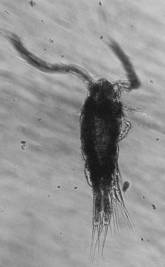
(Figure: Nauplii)
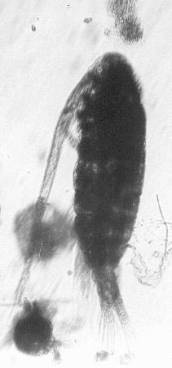
Calanoid copepod, Taal Lake (Photo: Rey Donne S. Papa, 2007)
FILIPINODIAPTOMUS, LAI, MAMARIL and FERNANDO 1979
(syn. Diaptomus)
Left outer branch of male fifth leg without circular
saw-like lobe. Hyaline process of the 3rd last segment
of the right first antenna of male short and serrated.
Basis of male fifth leg with 3 sigmoid protrusions.
Outer distal corner being of the exopodite of the
5th right male leg without processes (see NOTE).
Front part of female abdomen with peg-like spines
on genital segment.
119 a. Last segment of right fifth leg of male with short and
broad spine besides the terminal hook. Size of female
1400 μm. Postembryonic development, feeding habits,
and density fluctuations of its life history stage
in La Mesa Dam reservoir, has been reviewed by
Palomar & Mamaril (2001).
Endemic in Bulacan-Rizal-Laguna area. Mamaril (1978a)
reported it as far north as Nueva Ecija and Tarlac.
Recently Aquino et al. (2008b) found it together with
Tropodiaptomus australis in Paoay Lake. Found in lakes,
reservoirs, and rice fields. Endemic. Thus, the record
from Karela, South India, by Jose & Sanalkumar (2012)
has to be confirmed.
(Figures 119a1, 119a2, 119a3, 119a4, 119a5,
119a6, 119a7, 119a8,)
- Laguna de Bay (Nauplii, overview, copepodit,
female, egg, male, 5th leg), La Mesa Dam, Paoay Lake.
Filipinodiaptomus insulanus, (WRIGHT, 1928)
(syn. Diaptomus sensibilis)
[1928a+b, 1930a, 1933a, 1937b (with map).1979a, 1980, 1984a, 1986a, 2001, 2002a, 2008b]
F. insulanus nauplii
from Laguna de Bay
F. insulanus C1 from Laguna de Bay
F. insulanus Adult from Laguna de Bay
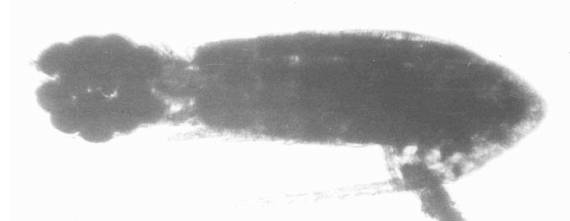
F. insulanus Female from Laguna de Bay
119 b. Last segment of right 5th leg of male with long and
sharply pointed spine besides the terminal hook.
Brehm (1933) has described this species from Danao
Lake, Leyte, while Lai et al. (1979) looked for it,
in vain, in Lanao Lake (Leyte), Mindoro. Brehm (1933d)
writes (translated): "Im Plankton von Danao Leyte
(Nr. 142 der Kollektion) fand sich eine mit dem
neulich aus der Laguna di Bay gemeldeten Diaptomus
insulanus verwandte Form". "Verwandte" (Ger.)
translates to "related" (Eng.). Since its morphology
is similar to Filipinodiaptomus insulanus, he only
added a single drawing to his description of this
new species of the males 5th leg, showing the long
spine. However F. vexillifer has not yet been
established as a valid name for Diaptomus vexillifer,
BREHM 1933, and the existence of the species has not
been confirmed (Augustus C. Mamaril, personal
communication).Endemic.- Danao Lake, Leyte(Leyte).
Filipinodiaptomus vexillifer, (BREHM, 1933)
(syn. Diaptomus vexillifer)[1933d, 1937b (with map), 1937
(misspelled: "Lanao-See"), 1941a]
ARCTODIAPTOMUS KIEFER, 1932
ARCTODIAPTOMUS KIEFER, 1932
119 c Differ from Filipinodiaptomus by the outer distal corner
being produced sharply of the exopodite of the 5th right
male leg (large wings). Size female 970 μm and 820 μm for
males in Tall Lake (2012b). Nearctic genus.Eutrophic. Its dispersal might have been boosted by a
general eutrophication of Philippine lakes, influences
by intensive aquaculture, together with transfer of
fingerlings from lake to lake. Invasive species, first
recorded in 1991. Occurred in 18 out of 27 lakes in the
archipelago (2012a). Ponds and lakes.Invasive species, first recorded in 1991. Occurred in 18
out of 27 lakes in the archipelago(2012a). Ponds and lakes.
- Lake Paoay, Laguna de Bay, Pasig River, Lake Taal, Naujan,
Lake Danao (Leyte) Lake Danao (Cebu),
Lake Mainit.
Arctodiaptomus dorsalis, (Marsh, 1907)
[2001d, 2003c(Arctodiaptomus sp.),2012b, 2012c]
MONGOLODIAPTOMUS, KIEFER 1932
Left outer branch of male fifth leg without circular
saw-like lobe. Hyaline process of the 3rd last segment
of right first antenna of the male membranous without
serration. None sigmoid protrusions on basis of male
right leg. No peg-like processes on the female abdomen.
120 a. Only one species in the Philippines,
which seems to be closely related to
Monglodiaptomus formosanus, KIEFER 1937.
Planktonic in lakes and ponds. Distribution
restricted. Rare.
- Ilocos Norte, Baguio City.
Mongolodiaptomus birulai, (RYLOV, 1924)
(syn. Diaptomus birulai,
syn. Eudiaptomus birulai)
[1978a,b, 1979a, 1986a, 2012a]
To 121a