Back to 141a - Back to content
THERMOCYCLOPS, KIEFER, 1927, (syn. Mesocyclops Thermocyclops) (subgenus)
First antenna with 17 segments reaching beyond the
cephalothorax. Last segment of fifth leg of female with
2 long setae. Inner setae on caudal branch more than twice
as long as outer setae. Last segment of fifth leg of female
with two terminal setae. First antenna without hyaline plate.
Planktonic.
Copepodits feed on zooplankton and phytoplankton when
it is abundant. Mainly tropical species. Often found
together with Mesocyclops in the plankton, e.g.
Laguna de Bay (Petersen, 1981e). It is presumed that
the smaller and larger species use different food sources.
See Ueda & Reid (2003a) for at comprehensive key of the genus.
However genus needs revision (Papa and Hołyńska 2013).
142 a. Connecting plate on fourth pair of legs without spines on
outgrowth. Caudal branch 2 times as long as wide. Longest
terminal setae not curved in Lanao material, but slightly
curved in Papua New Guinea material. Receptaculum seminis
with thin head, curved slightly posteriorly. Size 560-600 μm.
Differ morphologically from T. crassus in Lake Lanao only with
regard to length and length ratio. Thermocyclops wolterecki
thus appears to be a sibling species of T. crassus or possible
even just a morphotype (Lewis 1979b). Herbst 1986
(se Herbst 1986c) however, accept the status as species in
his key of Thermocyclop. In small waterbodies and planktonic
in lakes. Limnetic and littoral ecoforms with distinct
morphometric characters of smaller and slender form in
limnetic zone (Papa and Hołyńska 2013). Endemic for Mindoro
and Papua New Guinea.
- Lake Lanao, Mindanao.
Thermocyclops wolterecki, (KIEFER, 1938)
[1938a, 1941a, 1969, 1986c, 2002a, 2003a]
142 b. Connecting plate on fourth pair of legs with spines on
outgrowth..................................................143
143 a. Longest terminal seta curved at the tip and is 120-230 μm.
The wings of receptaculum seminis with broad head, only
slightly bended backwards. Caudal branch 2-2 1/2 times as
long as wide. Inner caudal setae (S1) 2.7-3.6 times as
long as the caudal ramus. Connecting plate on fourth pair
of legs with spines on outgrowth, by witch it might be
distinguished from T. decipiens together with its straight
spine in the inner distal segment of the endopodite.
Size 560-800 μm with at mean length of 490 μm for males
and 580 μm for females in Tall Lake (Papa et al., 2012b).
Feeds on diatoms (e.g. Nitzchia), cyanobacteria (blue
green algae, e.g. Anabaena) and cryptomonads. A preference
for elongate filaments or unicels has been found in Lake
Lanao (Lewis 1979b, se also Fernando 1980).
The abundance per unit area increased towards deeper
water in Lake Lanao. The ephemeral patchiness increased
with progressive stages in life history (Lewis, 1978d).
Dominating the zooplankton biomass and production in
Laguna de Bay together with Mesocyclops leuckarti in
1980 (Petersen, 1981e). Eurytherm. Planktonic in ponds
and lakes. Very common all over the Philippines.
Records need confirmation (Papa and Hołyńska 2013).
(Figures 143a1, 143a2, 143a3, 143a4, 143a5, 143a6,
143a7, 143a8, 143a9)
- Laguna de Bay (nauplii, copepodits C2+C3, C4,
female C5, female, male C6), Paoay Lake, La Mesa Dam,
Bunot Lake, Calibato Lake, Taal Lake, Naujan, Lake Lanao
Thermocyclops crassus, (FISCHER, 1853)
(syn. Mesocyclops (Thermocyclops) hyalinus)
[1939a, 1941a, 1978a+b, 1978d (T. hyalinus),
1979b, 1980, 1984a, 1986a, 1986c, 2001a,
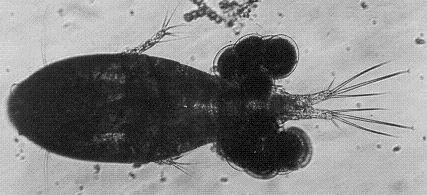
T. crassus Female from Laguna de Bay
143 b. Longest terminal seta curved at the tip. Caudal branch
2-2.5 times as long as wide. Inner caudal setae (S1)
1.9-2.3 times as long as the caudal ramus. Size 600-700 μm
- Cluster of lakes around San Pablo: e.g. Pandin and
Bunot Lakes and Camarin Sur: Buhi and Baao Lakes.
Thermocyclops taihokuensis HARADA, 1931
[2013]143 c. Longest terminal setae not curved at the tip.
The wings of receptaculum seminis with thin head,
bended slightly backwards...............................144144 a. The membrane connecting the bases of the fourth pair of
legs (swimming feet) has two rounded processes, with a
number of small spines on. Caudal branch 3 times as
long as wide. Longest terminal setae not curved.
Longest setae not curved. Receptaculum seminis with
thin head. In freshwater. Abdomen covered with small
dots in rows. Size of female 900-1000 μm.
In freshwater, not limnetic (Papa and Hołyńska
2013).
- Manila area
Thermocyclops philippinensis (MARSH, 1932)
(syn. Mesocyclops/Thermocyclops philippinensis)
[1932, 1986c, 2002a, 2003a]
144 b. The membrane connecting the base of the fourth pair
of legs (swimming feet) has two high and slime
outgrowth with bigger spines on. Caudal branch
2½ times as long as wide. Longest setae not curved.
Receptaculum seminis with thin head. Size of
female 760-790 μm. Planktonic in alkaline
lakes and reservoirs. Common.
- Naujan Lake
Thermocyclops decipiens, (KIEFER, 1938)
[1938a, 1941a, 2013]
144 c. In Lake Mainit is found a fourth species, different from the species mentioned above.
- Lake Mainit
[1973]
Note: Thermocyclops species in the "vicinity" of the Philippine Islands are:
T. operculifer (KIEFER, 1930) [Indonesia: Lesser Sunda Islands, Cambodia, and Vietnam],
T. trichophorus, KIEFER 1930 [Java],
T. ianthinus (HARADA, 1931) [Taiwan],
T. orientalis DUSSART & FERNANDO, 1985 [Sri Lanka, Malaysia, and Indien (?)].
(See 2003a, Herbst 1986c)
To 145a