Back to 41 b. - Back to content
CALYCIFLORUS GROUP
42 a. Anterior spines long, pointed, emerging from a broad base.
Polymorphic:
$ Spines on posterior margin absent (form calyciflorus,
form dorcas)
$$ Spines present (form amphiceros (long), form borgerti
(short) (syn. var. hymani).
Form borgerti distributed in oriental region (Kutikova, 2002).
With or without spines on foot opening. Spines are stiffen
and spread apart when attack by predator e.g. Asplanchna.
The same Asplanchna is shown to induce spine formation by
B. calyciflorus with a still unknown chemical factor.
(Wallace et al., 2006). Size 200-500 μm. Very polymorphic.
Food mainly algae (Chlorococcales (+/- Chlorella), Volvocales,
Euglenoides) with a size less than 18 μm diameter,
including Anabaena, which is eaten from the end. It shares
the same food niche as B. angularis, and will without
predation, e.g. from Mesocyclops thermocyclopoides, win the
interspecific competition (Kumar and Rao, 2001.)
B. calyciflorus is a eutrophic indicator (India).
Occurrence often coincides with the blooming of the cyanobacteria
(blue green algae) Microcystis aeruginosa. Ability for
co-existence of Brachionus species with cyanobacteria
is considered a pre-supposition for survival in tropical
lakes (Sharma, 1983). Often found to be infested with thick
growths of Chlorococcales (Sharma, 1983). Predate on
flagellates etc. (Wallace et al., 2006).
Planktonic in large and small waters, reservoirs, and large
rivers. Also in brackish waters. Indicator of eutrophic
waters (Sládeček 1983). Common.
-Laguna de Bay, Pasig River, Bunot Lake, Calibato Lake
(f. borgerti), Tadlac Lake, Taal Lake, Lake Mainit.
Brachionus calyciflorus, (PALLAS, 1766)
(syn. Brachionus pala)
[1941a (f. dorcas), 1966, 1978a+b, 1980, 1984a,
1986a, 1999, 2001a, 2009a, 2011a+b+c, 2012a]
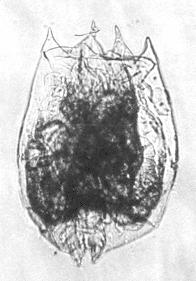
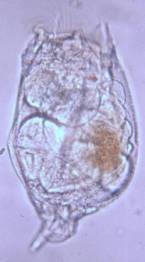
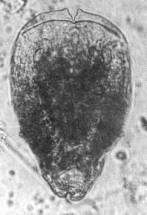
B. calyciflorus from Laguna de Bay
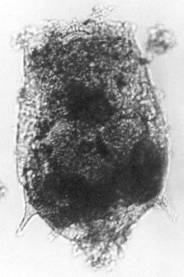
B. calysifloris f. borgerti
from Calibato Lake
B. calyciflorus from Laguna de Bay
B. B. calyciflorus
(Foto: Rey Donne S. Papa)
42 b. Anterior spines emerging from a narrow base, crooked.
Lorica with more or less pronounced folds,
no posterior spines present. Size 150 μm,
Mainly in freshwater. Indicator of mesotrophic waters
(Sládeček (1983).
- Laguna de Bay, Pasig River.Brachionus budapestinensis, (DADAY, 1885)
[1941a, 2009a]
ANGULARIS GROUP
43 a. With two median anterior spines present. Lateral
and submedian spines absent..........................44
43 b. Lateral spines present together with median spines....45
44 a. Body flat, dorsal and ventral lorica separate,
more or less granulated and with folds.
Pincer-shaped
median spines. Lateral spines reduced or absent.
Size less than 115 μm.
Dwarf form of Brachionus caudatus....................46 b.
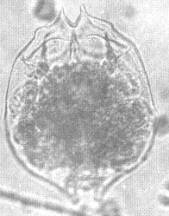
B. caudatus dwarf form
from Laguna de Ba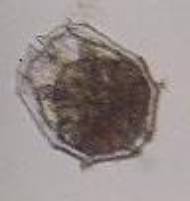
B. caudatus dwarf form
from Laguna de Bay
(Foto: Rey Donne S. Papa)
B. angularis from Laguna de Bay
44 b. Body lentiform. Lorica strong stippled and
with folds. All spines except the small
median ones, reduced and absent.
Highly polymorphic. Size 100-200 μm.
Food detritus and bacteria. It shares the samefood niche as B. calyciflorus, and will be
out-competed from this species if it is not
predated upon e.g. by Mesocyclops
thermocyclopoides (Kumar and Rao, 2001.)
Planktonic in lakes, also in
brackish water.Indicator of mesotrophic and
eutrophic waters (Sládeček 1983).
-Laguna de Bay, Pasig River, Paoay Lake, La Mesa Dam,
Calibato Lake, Taal Lake, IRRI rice field,
Lake Danao (Leyte/Cebu?).Brachionus angularis, (GOSSE, 1851)
[1941a, 1966, 1978 a+b, 1980, 1984a,
1986a, 1999, 2009a, 2011a+b+c]
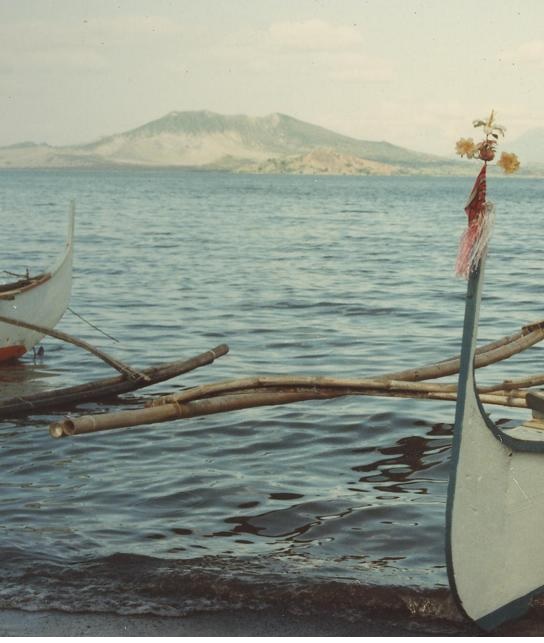
Taal Lake and Volcano, 1980
to 45 a.