Back to 67 a. - Back to content
GNESIOTROCHA, KUTIKOVA, 1970 (superorder)
FLOSCULARIACEA, (REMANE, 1933) (order)
TESTUDINELLIDAE,(BARTOS,1959) (family)
syn. Pterodina)Lorica present, i.e. cuticle thickened to form
a stiff shell (lorica), which retain its shape
well after preservation. Lorica strongly
flattened, circular in outline, foot opening
ventral, and foot ends in circle of cilia.
Jaws malleoramate.68 a. In fresh and brackish water.
Only one species planktonic. Indicator of mesotrophic
waters (Sládeček 1983).
- Laguna de Bay, Pasig River, Paoay Lake, La Mesa Dam,
Taal Lake, Lake Lanao, Calamba River,
IRRI rice field.
Testudinella patina (HERMAN, 1783)
[1978a+b, 1980, 1984a, 1986a, 1999,
2001a, 2008b, 2009a, 2011a]
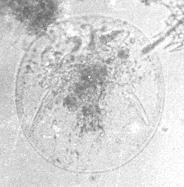
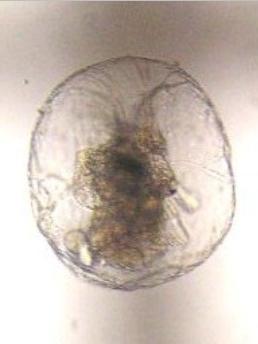
T. patina from Laguna de Bay
T. patina (?) (Photo Rey Donne S. Papa, 2007)
se also: http://forum.mikroscopia.com/index.php?s=808ba833eba6f030026c5634e51ab47b&showtopic=1068
POMPHOLYX, GOSSE 1851.
Lorica present, i.e. cuticle thickened to form a
stiff shell (lorica), which retain its shape well after
preservation. Typical inhabitants of warm pond plankton
(Wallace et al., 2006). Planktonic.
69 a. Lorica oval, 4 loped in cross section.
Planktonic in eutrophic ponds and lakes,
also in brackish water.
- Laguna de Bay.
Pompholyx sulcata, (HUDSON, 1885)
[1941a, 1974]
69 b. Lorica flattened, 3 loped in cross section.
Planktonic in eutrophic ponds and lakes,
not in brackish water.
- Taal Lake.
Pompholyx complanata, (GOSSE, 1851)
[2001a, 2011a]
TROCHOSPHAERA, SEMPER 1872
Without foot. Lorica absent, i.e. cuticle thin
and flexible, not usually retaining its shape
well after preservation. Large, spherical,
with corona (wheel organ) in equator of body.
(Wallace et al., 2006)
70 a. Feed on nannoplankton (small Staurasmus species),
detritus and bacteria. Warm stenotherm (20-32oC),
pH 5.9-7.5, and conductivity 35-110 μS cm-1.
In shallow waters like pond but especially in
rice fields.
- Rice field ditch.
Trochosphaera aequatorialis (SEMPER, 1872)
[1875 (in 1978c), 2002c]
To 71 a.