CONOCHILIDAE, (REMANE, 1933) (family)
Jaws malleoramate. Fulcrum short, rami
more or less triangular, flat; unci teeth
numerous. Planktonic and epiphytic on roots of
Eichornia (Water hyacinth),
(Arora and Mehra, 2003c).CONOCHILUS, EHRENBERG 1834
Foot fairly stout, without toes. Lorica absent,
i.e. cuticle thin and flexible, not usually
retaining its shape well after preservation.
A gelatinous, transparent case around foot
and part of the body Head not funnel-like.
Solitary (Conochiloides) or in colonies
(Conochilus). Conochilus disappeared from
Laguna de Bay in periods with relatively
high salinity, thus showing sensitivity to
the increased salinity. Formalin-preserved
specimens separated from gelatinous case.
Formalin-sugar-preserved specimens still
in gelatinous case, usually strongly contracted.
Antenna present, planktonic. The genus
Conochilus, EHRENBERG 1834, and Conochiloides,
HLAVA 1904, can be separated based on the degree
of fusion of the antennae. However,
intermediates between total fused and unfused
antennae are found and the two genera will be
treated as one (Conochilus) with two separate
groups (Ruttner-Kolisko 1972). Feeds on
particles less than 10 μm (Sládeček 1983).
74 a. Antenna more or less separated,
CONOCHILOIDES GROUP.................................7574 b. Antenna fused completely or nearly so,
CONOCHILUS GROUP....................................76CONOCHILOIDES GROUP
Antenna more or less separatedCONOCHILOIDES, HLAVA 1904
75 a. Antennae largely fused proximally to about
one-third the length and free and the distal end,
situated below corona. Basal mound is lacking.
Mouth central. Right uncus has five large teeth,
the left uncus three. Solitary in gelatinous
case – not colonial. Body vase shaped.
Size (without case, expanded) 250 μm.
Feeds on unicellular algae up to 18 μm
and shows affinity to bluegreen-algae
in Lake Lanao (Lewis 1979b). Planktonic
in lakes and ponds, thermophilic. Rare.
- Laguna de Bay, Lake Mainit, Lake Lanao, Paoay Lake.
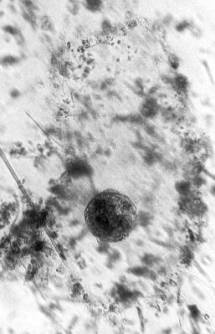
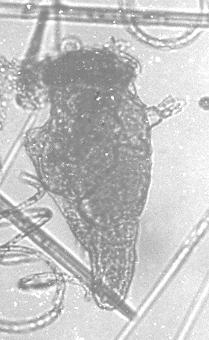
Conochilus dossuarius, (HUDSON, 1885)
(syn. Conochiloides dossuarius)
[1941a, 1973, 1977, 1978a+b+d 1979b,
1980, 1984a, 1986a, 2003b, 2008b]
C. dossaurius from Laguna de Bay
C. dossaurius from Bunot Lake
75 b. Ventral antennae arise from a mound-like
expansion of equal length as the antennae,
which are separated in their total length.
Ventral antenna prominent. The foot is short
and almost entirely contracted when fixed.
Each uncus has three large teethes; one of
the teeth of the left uncus is divided into
three branches, however. Total length 160 μm.
Body length 110-115 μm;
- IRRI Rice field, Lake Danao(Leyte/Cebu?).
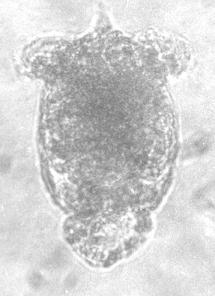
Conochilus coenobasis SKORIKOV, 1914.
[1999]
CONOCHILUS GROUP
Antenna fused completely or nearly so.(CONOCHILUS, EHRENBERG 1834)
76 a. Antenna fused completely or nearly so,
situated in the mouth field or the corona,
mouth dorsal. In colonies of varying size
(5-12 individuals), living together
in a spherical gelatinous hull. The colony
is less vulnerable to be attacked by
Asplanchna and probably by copepods, too.
Efficient consumer of bacteria-sized
particles and thus an important consumer
within the microbial loop
(Wallace et al. 2006).
Planktonic in oligotrophic lakes and ponds
(Sládeček (1983).
- Laguna de Bay, Sampaloc Lake.
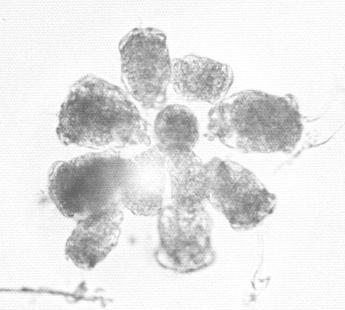
Conochilus unicornis, (ROUSSELET, 1892)
[1980, 1984a]
C. unicornis from Laguna de Bay
C. unicornis fromSampaloc Lake
To 77a