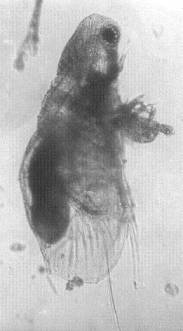
D. orghidani(?) from Laguna de Bay
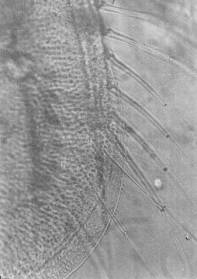
D. orghidani (?) . With about 28 spines on postero-ventral edge of shell. From Laguna de Bay D.
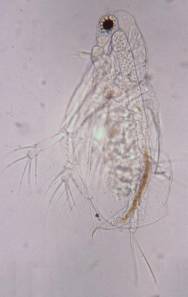
D. orghidani(?) Live speciment from Laguna de Bay
89
a. Head relatively small, its dorsal part not protruding,
with even top,
forming less than one-fourth of total
length. Compound eye in frontal, vaulted
part, close
to top. With well developed dorsal pert. 2nd antennae
short, reaching to 2/3-3/4 of shell (carapace) length.
Postero-ventral margin of shell (carapace) with 8-32
(often 10-18 in ssp. orghidani
and 22-29 in
ssp. transamurensis) mostly
large and widely spaced
spines and thin setules between them. Small ventral
inflection of the shell, which is shifted much anteried,
carrying up to 8 long,
feathered setae. With short acute
spine on the outer side on the end of upper antennal
branch (Korovchinsky, 1991). Size 660-1200 μm,
head/body
length 0,38-0,43, 2nd antenna/body length 0,68-0,84
(Weiler,
1997, ssp. orghidani) (Figures
89a1,
89a2).
Polymorphic species. Production of Diaphanosoma "modigliani"
(D. o. transamurensis) in Lake
Lanao is associated with
small to
medium size algae (e.g. Cryptomonads)
of round
or oblong shape (Lewis 1979). Predated
by fish
and
Chaoborus.
Diaphanosoma orghidani, NEGREA, 1982.
Key to subspecies:
Postero-ventral edge of shell (carapace/valve) with not
more than 18-20 denticles.
- Not recorded from the Philippines.
Distributed in Western Eurasia
Diaphanosoma orghidani orghidani,
NEGREA, 1982.
Postero-ventral edge of shell (carapace/valve) with more
than 20 denticles. Showed a high degree of ephemeral
patchiness in Lake Lanao (Lewis, 1978d). It co—occurs
with D. sarsi (Lake
Lanao) and D. excisum (Laguna de Bay).
– Lake Lanao, Mindanao,
- Illaguen River,
Ixabila, North-Eastern Luzon
- Laguna de Bay (female).
Diaphanosoma orghidani
transamurensis, KOROVCHINSKY, 1986
[1969, 1979b, 1980,
1984a, (D. modigliani)
1991,
1992, 1998a, 2000a+b, b (D. orghidani)]
|
|
D. orghidani (?) . With about 28 spines on postero-ventral edge of shell. From Laguna de Bay D. |
D. orghidani(?) Live speciment from Laguna de Bay
|
Note 1:
Diaphanosoma species belonging to the D. brachyurum – group
has been found
e.g. in Sumatra. The dorsal part of the head
is - like D. orghidani -
relatively weakly developed, not or
only weakly protruding. However the
spines (denticles) of
postero-ventral shell (valve) margin differ strongly
in form
and size; small intermediate spines are situated between large
ones.
The name "D. brachyurum" has been incorrectly used
designation of other
species of the genus e.g. D. orghidani,
which probably is case with
the following record for the
Philippines. Found Indonesia, Africa and
America with similar
forms to Diaphanosoma brachyurum s. str.
(LIEVEIN, 1848))
which is found in Europe and Asia. The systematic status of
those forms is still unclear. (Negrea, 1982, Korovchinsky, 1992)
- Laguna de Bay (?).
Diaphanosoma brachyurum – group
(syn.
Diaphanosoma perarmatum (BREHM, 1933))
[1954
non D. brachyurum (?)]
89
b. Head large, but forming less than one half of the shell (carapace)
- one third of the body size,
with dorsal part strongly protruding.
Marginal spines large, not very numerous
(22-58), apical spine on
the outer side on the end of upper antennal branch strongly
curved.
Dorsal side of postabdomen strongly convex, prominent. Ventral
valve
inflexion Comparatively long and not shifted proximal.
Lives in large and
small reservoirs, mostly in limnetic but also
in littoral zone, in ponds,
fishponds, mining pools and stream
backwaters. Rare.
Figures
89b1,
89b2
- Paoay Lake, Talasay Batangas,
Taal
Lake,
Laguna de Bay.
Diaphanosoma tropicum,
KOROVCHINSKY, 1998
[1991, 1998a (type species), 2000a, 2002a,
Note
2: Head large, with dorsal part strongly
protruding. Marginal spines
small, very numerous (55-86), apical spine on the outer side of the
end of upper antennal branch slightly curved or
straight. Dorsal side
of postabdomen flatly convex, not prominent. Ventral valve
inflexion
comparatively short and shifted proximal. D. modigliani inhabits Lake
Tempe and Lake Toba in (Sumatra,
Indonesia). Rare.
Probably synonymous with D. tropicum or D. orghidani
(Lake
Lanao, Korovchinsky,
2000a) and
maybe D. dubium,
in the Philippines, since D. modigliani is only found
in Indonesia. (Korovchinsky, 1991+1998).
- non-Laguna
de Bay (?), non-Lake Lanao (syn.?).
Diaphanosoma modigliani,
RICHARD, 1894.
[1939c,
1941a, 1978a+b+d (non D. modigliana), 1979b
1980, 1984a (D. orghidani), 1986a]
89
c. Head very large, robust, cone shaped, with dorsal part protruding,
length almost one half of shell (carapace). Without ventral fold
on shell with
only narrow inflection merging gradually with
postero-ventral margin. Row of
small spines along postero-ventral
margin of shell are not numerous,
mostly 12-29 (8-40).
Representatives
from tropical regions rather small: Body size:
760-940 μm,
comparatively small head, large eye in specimens
from Philippines and Thailand (Korovchinsky,
2000b). Planktonic
in lakes, reservoirs, fishponds and rivers (Philippines).
-
Sampaloc Lake, Laguna de Bay, Lake Baao,
Illaguen River, Ixabila,
North-Eastern Luzon.
Figures
89c1,
89c2
Diaphanosoma dubia,
MANUILOVA, 1964
(syn. Diaphanosoma dubium,
MANUILOVA, 1964)
[1998a, 2000b, 2014]
|
TABLE: The morphological differences between D. orghidani, D. modigliani, D. tropicum and D. dubia. Se Korovchinsky (1998a+2002b) and Weiler (1998) |
|||||
|
Species: |
|||||
|
Traits: |
|||||
|
0 |
Status in the Philippines |
Recorded |
Philippine records now regarded as |
Recorded |
Recorded |
|
1 |
Head |
Head small, rectangular, with well-developed, high dorsal part not protruding. |
Head large, protruding dorsally, less than half of shell length |
Head large, protruding dorsally, less than half of shell length |
Head very large, more massive, protruding dorsally, nearly half the length of shell |
|
2 |
Spine on the end of upper antennal branch |
Short acute |
Slightly curved or straight |
Strongly curved |
Extremely variable. Straight to strongly curved |
|
3 |
Ventral shell (valve) fold (inflexion) |
Small ventral inflection of shell noticeable shifted proximal |
Comparatively short and shifted proximal |
Comparatively long and not shifted proximal |
Large, narrow |
|
4 |
Denticles of ventro-posterior valve margin |
Few: 19-32 (more often 22-29) in ssp. transamurensis, |
Small and very numerous: 55-86 |
Comparatively large and not very numerous:
25-43 |
Small and very few: 12-29 (min.-max. range 8-40) |
|
5 |
Postabdomen and terminal claws |
Dorsal part not prominent. |
Dorsal part not prominent, basal spines short |
Dorsal part prominent, basal spines comparatively long |
Dorsal part prominent. |
|
6 |
Head length: Body length (%) |
39,0 |
39,8 |
44,6 |
49,7 |
|
7 |
Diameter of eye: Body length (%) |
9,0 |
6,6 |
7,8 |
7,4-11.1 |
|
8 |
Length of 2nd antenna: Body length (%) |
76,5 ssp. orghidani
|
69,6 |
63,7 |
61,4 (Philippines: 65,2-78,3) |
To 90a