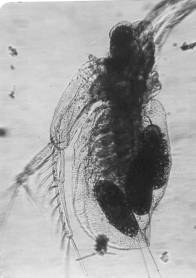
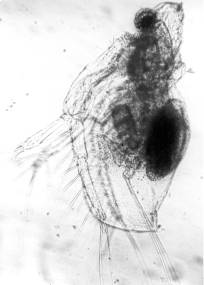
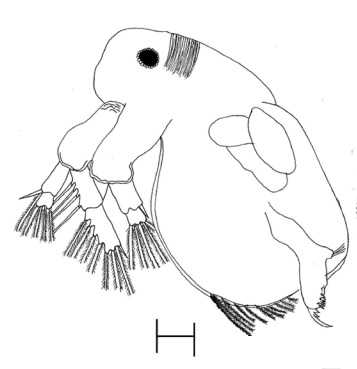
90 a. Distinct free flap (duplicature) narrow, not rounded on
distal end, joining the ventral margin at right angle.
Eye relatively small. Size 650-800 μm. Swimming antennae
strong and long. Planktonic, inhabiting different water
bodies, including acid, turbid (Laguna de Bay) and
slightly brackish (up to 2 o/oo) waters. Rare to common
in waters with aquaculture.
(Figures 90a1, 90a2, 90a3, 90a4)
- Laguna de Bay (juvenile, adult), Taal Lake.
Diaphanosoma excisum, SARS, 18861
[1978a+b, 1980, 1984a, 1986a, 2011b+c, 2012b, 2014]
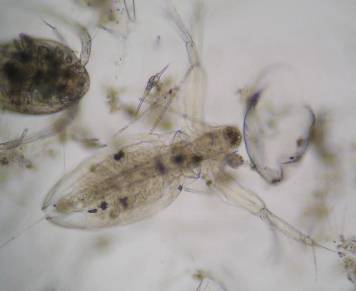
D. excisum from Laguna de Bay
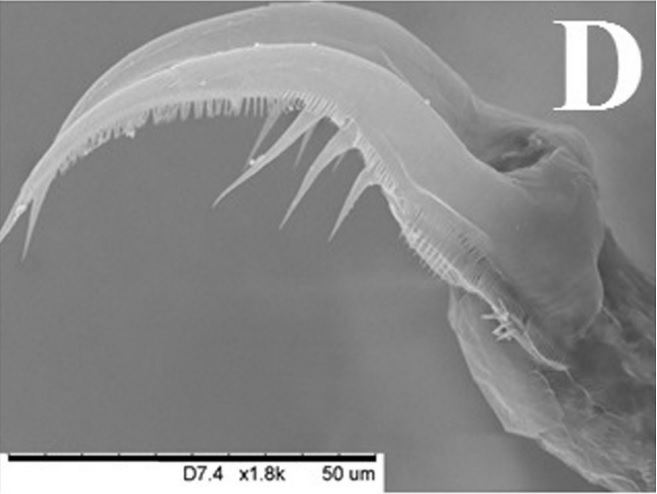
D. excisum. Claw Scanning Electron Micrograph. (Pascual et al. 2014)
90 b. Distinct free flap (duplicature) broad, rounded on
distal end, with feathered and naked setae on edge.
Head small. Eye big. With 8 setae on distal upper
segment of antennal branch (see note). Adapted to
life near shore shallow waters: The swimming function
of the 2. antenna is adapted to contact with the
substratum (lower branch is more developed) and
1. antenna relatively large. Weak and short. Large,
broad free ventral flap (duplicature)) on the shell
(carapace) protect the filtering limps from clogging
(Korovchinsky, 1986). Inhabiting different water bodies:
lakes, reservoirs, ponds, swamps, rivers, rice fields
and pools. Probably mainly in the littoral zone and
shallow vegetated waters, but also in pelagic zone
of some large lakes. pH range 5.8-8.4. Very common.
(Figures 90b1, 90b2)
- La Mesa Dam, Tadlac Lake, Taal Lake, Lake Sampaloc, Lake Lanao,
Illaguen River, Ixabila, North-Eastern Luzon, Paoay Lake.
Diaphanosoma sarsi, RICHARD, 1895
[1939c, 1941a, 1966, 1973, 1978a+b+d 1979b,
1986a, 2000, 2001a+c, 2005a (D. sp.), 2008b,]
2011a+b+c, 2012a+b, 2014c]
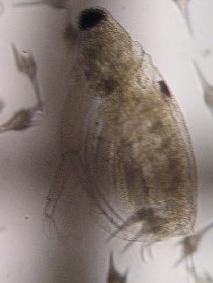
D. sarsi From Taal Lake.
Rey Donne S. Papa
D. sarsi. From Taal Lake. Rey Donne S. Papa
90 c. With distinct free flap (duplicature) rounded on distal
end like D. sarsi, but with naked setae and setules and
without ornamentation. With only 7 setae on distal upper
segment of antennal branch. Long confused with D. sarsi,
this species is widely distributed in the tropics and
subtropics of the Eastern hemisphere. Mostly in shallow,
vegetated habitats. Rare, not planktonic.
- Found In ponds in the Philippines.
Diaphanosoma volzi STINGELIN 1905
[1995]
Note: Diaphanosoma celebensis, STINGELIN, 1900, with distinct
free flap (duplicature) rounded on distal end like D. sarsi,
but with naked setae and setules. With only 7 setae on
distal upper segment of antennal branch is found in the
region outside the Philippines.
Some littoral species of the family can be found sporadically in
pelagic plankton samples like:
Head not clearly delimited from the body. Antennule with a
longer sensory setae than its basipodite, eye situated more
dorsally:
Latonopsis australis SARS (Taal Lake
[1939c, 1966, 2001a, 2011a, 2014]),
which was found adapted to planktonic
life in a lake on Sumatra (Woltereck, 1941a), and Pseudosida bidentata,
see Mamaril (1986a) and Korovchinsky (1992).
Latonopsis australis. Pascual et al. 2014
To 91a