MOINIDAE, GOULDEN 1968 (family)
Second antenna with dorsal branch 3-segmented and
ventral branch 4-segmented. First antenna long,
moveable, situated on the ventral side of the
large head. For further information see
Goulden (1968).MOINA, (BAIRD 1850
Ocellus eye absent, only compound eye present.
Food: algae, bacteria and detritus. Preyed upon
by fish and phantom midge-larvae.
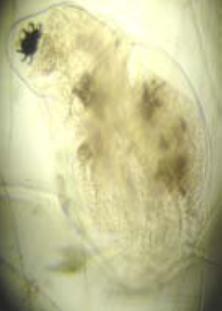
93 a. Distal claw on postabdomen without big spines.
Spine on the second last segment of 1st thoracic
limp with row of strong spines. The dorsal margin
of the postabdomen has rows of thin setae. Head
rounded, without depression over the eye, except
on very large specimens. Ephippium with 2 eggs.
Size up to 1800 μm. Often used in zooplankton
cultures fertilized with cow dung and soil to
produce bacteria as food. Reproduce up to 35oC.
Lethal temperature is 48°C. Xu (1993) has studied
the effect of infection of Moina macrocopa by a
colonial peritrich, Epistylis daphniae as a phoretic
epibiont. In eutrophic ponds and fertilized fishponds,
also in brackish water, up to 22 ppt salinity. Common.
(Figures 93a1, 93a2)
- Ponds in Manila (Muntinglupa), Paoay Lake
Moina macrocopa, (STRAUS, 1820)
[1937a, 1954, 1968, 1978a+b, 1980, 1984a, 1986a, 2008b]
93 b. Distal claws on post abdomen with big spines. Spine on the
second last segment of 1st thoracic limp with row of fine
setules. Head with depression over the eye.
Ephippium with one egg......................................94
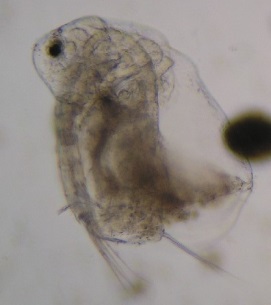
Moina sp, Taal Lake (Photo: Rey Donne S. Papa, 2007)
94 a. Distal claws on postabdomen with a row of small
spines decreasing in size distally. Hairs on
ventral surface of head, behind the 1st antenna,
absent. Adult small, measure less than 1OOO μm (l mm)
with an average of 560 μm in Taal Lake
Ephippium reticulated all over its surface.
Shows remarkable affinity for the cryptomonad
algae, which evidently are very good food sources
(Lewis 1979b). Undergo dial vertical migrations
within the water column (Hare, 2006). Showed a
high degree of ephemeral patchiness
in Lake Lanao (Lewis, 1978d).
Pelagic in lakes, but more common in the
littoral among plants. Common.
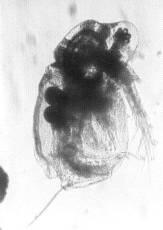
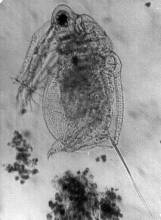
(Figures 94a1, 94a2, 94a3, 94a4, 94a5, 94a6, 94a7)
- Laguna de Bay (juvenile, female, male), Sampaloc Lake,
Tadlac Lake, Taal Lake, Lake Lanao, Paoay Lake.
Moina micrura, KURZ, 1874
(syn. Moina dubia, macrophtalma – M. micrura is probably
a sibling group of species, rather than a cosmopolitan
species).[1939c, 1941a, 1954 (M. weismanni),
1966 (M. dubia f. parva), 1968, 1969, 1974,
1978a+b+d 1979b, 1980, 1984a, 1986a,2000, 2008b+e, 2011b+c, 2012a+b, 2014]
M. micrura from Laguna de Bay
M. micrura, male from LagunadeBay
94 b. Distal claws on post abdomen with 11-14 large
spines. Large form, adult measures 1000-1600 μm.
Ephippium reticulated only around the edges.
Planktonic in mesotrophic lakes, ponds, marshes
and rice fields, also in salt lakes up to
36 ppt salinity. Rare. Probably not present in
the Philippines (Pascual et al. 2014)
- San Nicolas, MarikinaMoina brachiata, (JURINE, 1820).
[1978a+b, 1986a]
M. brachiata (?) (Photo: Rey Donne S. Papa, 2007)
MOINADAPHNIA, (HERRICK 1887)
One ocellus eye and compound eye present.
95 a. One species. Bottom dwelling, filtering the water
surrounding the weeds. Littoral, occurring in
temporary ponds, small lakes, pools, swamps,
and rice fields. Frequently occurring in limnetic
zooplankton samples (Kořínek, 2002a) Common.
Figures 95a1, 95a2
- La Mesa Dam, Taal Lake, Lake Calig.
Moinodaphnia macleayi, (KING, 1853)
[1968, 1978a+b, 1986a, 2001a, 2011a, 2014]
To 96a