BOSMINIDAE, BAIRD 1846 (family)
Second antenna with dorsal branch 3-segmented and
ventral branch
4-segmented. First antenna fused with the rostrum
of head, forming a snout like formation. Feeds on
small phytoplankton algae and/or bacteria depending
on availability. Preyed upon by invertebrate
predators.
BOSMINA, BAIRD 1846.
First antenna not united at base, distal part parallel
to each other. Post abdomen rectangular in shape with
oblique anal opening.
Asplanchna feed on particles larger than 10 μm like
Bosmina, catching the individually (Sládeček 1983).
The genus was represented in Taal Lake in a number
of 30 individuals/L in December.
- Taal Lake
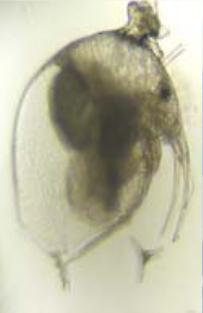
Bosmina sp.
[2005a]
Bosmina sp, Taal Lake (Photo: Rey Donne S. Papa, 2007)
BOSMINA BOSMINA Baird, 1845 (subgenus)
96 a. Claw on postabdomen proximally with 3-4 long spines
increasing in length distally. After these follows
2-6 small spines and 15 very fine spines. Frontal
sense hair midway between the junction of first
antenna and eye. Lateral head pore close to ventral
rim of triangular extension of head shield, close
to insertion of 2nd antenna. Size up to 620 μm.
Planktonic in lakes. Kořínek found only B. fatalis
in the 1970-71 Lake Lanao-samples, and this is almost
certainly identical with Woltereck's (1941a)
B. longirostris, se Lewis (1979b). Negatively affected
by bloom of green algae Botryococcus braunii blooms
in Paoay Lake (Papa et al., 2007a, 2008d).
The populations of B. longirostris in the tropics are
most probably sibling species of that described by
O. F. Müller from Danish rivers (Kořínek, 2002a) or
B. fatalis, with a morphological variation like
D. longirostris (Pascual et al. 2014). The use of
head pore morphology would exclude confusion among
the two species.
Common - if a good species for the Philippines.
- Danao Lake (Leyte/Cebu?), Ponds around Lake Lanao, Paoay Lake, Taal Lake.
- Lake Lanao, Paoay Lake.
Bosmina longirostris (MÜLLER, 1785).
[1928a, 1934a, 1939c, 1941a, 1969, 1978a+b, 1986a,2000?, 2001a, 2003b, 2008b+d+e, 2011a+b+c]
Note: B. longirostris has in India been a misidentification
of the superficially similar Bosmina tripurae KOŘÍNEK,
SAHA & BHATTACHARYA, 1999. With lateral head pore
pattern as in B. fatalis. The post abdomen claw with
basal pecten of 7-9 spines, growing in size distally
and, like B. longirostris, with a dorsal row of small,
sturdy spines (spinules). Distributed in India (lowland),
China, Japan and Indonesia and probably New Zealand (
Kořínek, 2002; Kořínek et al., 1999, Taylor et al., 2002)
BOSMINA SINOBOSMINA Lieder, 1957 (subgenus)
Only one species.
96 b. Claw on postabdomen proximally with 6-8 spines increasing
in
length distally, continuing in very fine spines to the
tip of the claw. Frontal sense hair near the junction
of the first antenna with the head. Lateral head pore
shifted dorsally, over mandibular articulation. Size
of adult female 370-600 μm, with an average of 390 μm
in Tall Lake (Papa et al., 2012b and Pascual et al., 2014).
Shows a remarkable affinity for cryptomonads in Lake
Lanao (Lewis 1979b). In lakes and reservoirs, abundance
in January in Tall Lake (Papa et al., 2012b). Planktonic
in Lakes. Predated upon by Sardinella tawallis (Clupeidae)
in Taal Lake during the northeast monsoon season coinciding
with a drop in copepod abundance (Papa et al., 2008, 2012b).
Common.
(Figures 96b1, 96b2)
- Laguna de Bay, La Mesa Dam, Sampaloc Lake, Tadlac Lake.
Naujan Lake, Lake Lanao.
Bosmina fatalis, BURCHARDT, 1924.
[1934 (form philippinensis), 1938c, 1941a, 1954, 1978a+b+d,
1979b, 1980, 1984a, 1986a,2000a, 2001a, 2001a, 2008e, 2011a+b+c]
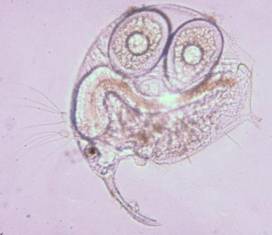
B. fatalis from Laguna de Bay
B. B. sp (Foto: Rey Donne S. Papa)
BOSMINOPSIS, (RICHARD 1895)
First antenna united at base and diverging
from each other. No apparent lateral head pore.
Post abdomen cone-like with rounded tip.
97 a. Only one species. Size 100-500 μm.
In lakes and reservoirs.
Rare.- Laguna de Bay (?), Naujan Lake, Lake Lanao (?), Davao Lake.
Bosminopsis deitersi, RICHARD, 1895
[1934, 1939c, 1941a, 1969, 1974, 1978a+b,
1986a, 2000(?), 2014]
To 98a